Strange & Unusual Dictionaries: Select a Book to Read Online About the Author
A Turkish Delight of musings on languages, deflations of metaphysics, vauntings of arcana, and great visual humor.
From Our Abecedarian Blog . . .

Today — February 15, 2026

I Found a Penny Today, So Here's a Thought (permalink)

MAD MIKE'S INTERVIEW WITH GRAVE MOOD RINGS

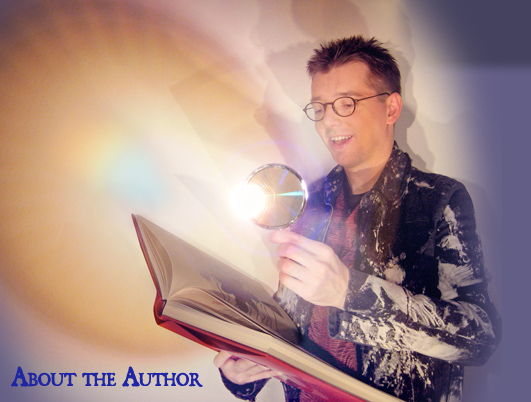
Professor Oddfellow (aka Craig Conley) is the author of dozens of books which can be found at his WEBSITE (https://www.oneletterwords.com/craigconley/), and co-creator of the new sketch comedy/horror show GRAVE MOOD RINGS (https://www.mysteryarts.com/grave-mood-rings/). Today we sit down to discuss his career as an author of the obscure, and go behind the scenes of the hit show!

MAD: Professor! Thanks so much for taking some time with us at Horror to Culture and the Scary Salad Network! Can you please give viewers a little insight into what they might expect from Grave Mood Rings, and how did the concept come about?

PROF: A recent viewer of our show commented, "Stop putting acid in my tea!" Grave Mood Rings is typically seen as trippy and Dada in the sense of absurdist humor. We lovingly poke fun at vintage tv horror, with rapid-fire jokes and ridiculous situations within a 1970s vampiric manor house. One main inspiration has been the classic slow-moving Gothic soap opera Dark Shadows, but nothing's slow in our treatment. We make up for a zero budget by pouring hours of intricate post-production into literally ever second. The series actually started as a one-off interruption of my show Prof. Oddfellow's Penetralia, as if another broadcast surreally started tuning into the wrong frequency and the two shows suddenly overlapped. But we loved the characters enough to keep bringing them back (and, ahem, it felt good to get more mileage out of the costumes).

MAD: Not only is Grave Mood Rings watched religiously by billions of people across the globe, and surely aliens in outer space, but you also have a novelization! Please tell us a little bit about the book adaptation.

PROF: Thank you for acknowledging our massive audience on this and other worlds, and (easy mistake to make) let's not leave out viewers from higher dimensions and from parallel realities. The dearly departed should also be included, for, if it weren't for ghosts, who knows where we'd be. Yes, I wrote a novelization of Grave Mood Rings because that idea started as a total joke in the show's closing credits: "Demand a novelization." A few people actually did demand it, and rather than rehash existing scripts into narrative form, I thought it would be more fun to come up with all new material in the overblown style of the first Gothic horror novels. The legendary horror host Dr. Sarcofiguy, a.k.a. John Dimes, voiced the entire novelization for its audio book incarnation.

MAD: Speaking of books, you have written, or contributed to, dozens of them. Yet, before any of the lavish fame and fortune, you were teaching college courses in creative writing and literature. How did you make the jump from academics, to focus on becoming an author?

PROF: I think it's at least 100 books by now. Who was it who said, "Go overboard or stay within reasonable limits"? Academia isn't about free thought or intellectual innovation, so I fled it to spend full time on completing a dictionary of one-letter words (which got published by HarperCollins).

MAD: You have an impressive back catalog of publications. What might you suggest for new readers of your work? Do you have any personal favorite title releases?

PROF: Personal favorites are Books of the Dead, A Field Guide to Identifying Unicorns by Sound, and How to Be Your Own Cat. I'm also especially fond of Webster's Dictionary of Improbable Words, which I wrote to be a word gamer's ultimate secret weapon.

MAD: Who are some of your favorite authors and inspirations?

PROF: Oh my, where to begin? I agree with Carl Jung that the Tibetan Book of the Dead is the most remarkable artifact of humanity. Philip K. Dick's entire body of work. Italo Calvino's If On a Winter's Night a Traveler. Samuel Butler's two astonishing Erewhon fables and the novel The Way of All Flesh. Umberto Eco's Name of the Rose. Charles Dickens' Bleak House. Herman Melville's Moby Dick. Most anything by William Faulkner. Eudora Welty's entire body of work. John Cowper Powys' Porius. Thomas Mann's The Magic Mountain. James Stephens' The Crock of Gold. D. H. Lawrence's Sons and Lovers. Tim Powers' entire body of work. Norman Mailer's Ancient Evenings. Elias Canetti's entire body of work. Gabriel Garcia Marquez's One Hundred Years of Solitude. Frank Herbert's Dune novels.

MAD: You guys not only handle all the writing, production, and editing for Grave Mood Rings, but also provide most of the music and jingles. Please tell us about your musical background, and how the songs for the show come about?

PROF: My partner and I began recording and releasing electronic dance music in the mid-1990s and ran our own record label for years. We invented the haunted clockwork / Tesla spirit radio genre and still record such as Neons Gone Mad. For Grave Mood Rings, we first seek to collaborate with old and new friend, preferring to add our own lyrics to pre-existing or custom instrumentation. I also like to homage favorite tracks through whimsical cover versions. Most of the Grave Mood Rings songs — surely over 60 this point — tend more toward jingles because we like to keep the proceedings snappy. Due to the 1970s setting, it's supposed to all be Disco, but we end up doing whatever feels right at the moment. We probably spend as much time on sound design as on the visual editing.

MAD: You have a lot of variety going on, with several different skits and scenes. How long do you typically work on a single episode, and how does the process work?

PROF: We have a troupe of writers and a backlog of unproduced scripts, so the arrival of a new horror host bumper clip tends to motivate us to pair it with a script or to write a new accompanying story. I'm extraordinarily inspired by collaborations and by viewer comments and suggestions. We basically "do requests." Because we have only one actor to play all the roles except for my Prof. Oddfellow character, we must film each element separately with an eye toward the compositing process. The assembly and post-production requires about 3 hours per completed minute of footage.

MAD: Realistically, if you could have any guest star make an appearance on your program, still living, who would you choose?

PROF: Elvira would be amazing. Someone please ask her for us. It's difficult to think of the living, actually.

MAD: Favorite horror film of all time?

PROF: There are so very many favorite horror films, but The Lost Boys easily tops the list.

MAD: Once again, we appreciate you taking some time with us, and hope for future collaborations! Is there anything you would like to close with today?

PROF: It's scary out here in the wastelands of indie culture. We need promotion! It's not paranoia to say that the powers that be suppress original voices. This is a bizarre, post-WTF world, and Grave Mood Rings has to date offered over 200 post-post-WTF episodes to help us all retain our sense of humor. Let's do this together.

. . . read more from I Found a Penny Today, So Here's a Thought . . .


Separated at Birth? (permalink)
Our custom widget that checks for duplicated images suggested this unlikely pairing.  Click each image for its source.
138435 111746
. . . read more from Separated at Birth? . . .


Restoring the Lost Sense (permalink)
From In and Out-Door Playgames by Carolyn Sherwin Bailey and illustrated by Cobb Shinn, 1923.
. . . read more from Restoring the Lost Sense . . .


Restoring the Lost Sense (permalink)
From Hobbies Weekly, 1938.
. . . read more from Restoring the Lost Sense . . .


Restoring the Lost Sense (permalink)
From Children of the Dawn by Evan Davies and illustrated by Cyril Cowell, 1938.
. . . read more from Restoring the Lost Sense . . .


Restoring the Lost Sense (permalink)
From Historic Costume by Katherine Morris Lester and illustrated by Ila McAfee, 1925.
. . . read more from Restoring the Lost Sense . . .


Restoring the Lost Sense (permalink)
From Black Beauty by Anna Sewell and illustrated by Lucy Kemp-Welch, 1915.
. . . read more from Restoring the Lost Sense . . .


Restoring the Lost Sense (permalink)
From Travel By Air, Land, and Sea by Hanson Hart Webster, 1933.
. . . read more from Restoring the Lost Sense . . .


Restoring the Lost Sense (permalink)
"It is discourteous to give 'first aid' to spots and stains while at the table."  From Home and Family Living by Fleck, Fernandez & Munves, 1959.
. . . read more from Restoring the Lost Sense . . .


Old News (permalink)
"Why is it that our most trivial habits often arouse violent resentment in others?"  From The Australian Women's Weekly, 1968.
. . . read more from Old News . . .


Old News (permalink)
"When there was something to say."  From Calvin College's 1957 yearbook.
. . . read more from Old News . . .


Restoring the Lost Sense (permalink)
From B.A.R., 1980.
. . . read more from Restoring the Lost Sense . . .


Yearbook Weirdness (permalink)
"Sunshine."  From Presbyterian College's 1916 yearbook.
. . . read more from Yearbook Weirdness . . .


Restoring the Lost Sense (permalink)
A Tibetan admonitory mask, from Masks and Demons by Kenneth Macgowan, 1923. 
. . . read more from Restoring the Lost Sense . . .


Yearbook Weirdness (permalink)
From the College of William and Mary's 1912 yearbook.
. . . read more from Yearbook Weirdness . . .


Restoring the Lost Sense (permalink)
Note the cute inclusion of sleepy Zs amidst the Xs of the tabby stripes, as well as the paw pad Os.  From Invent Your Own Computer Games with Python.
. . . read more from Restoring the Lost Sense . . .


Yearbook Weirdness (permalink)
From Salem College's 1950 yearbook.  See Of Feeding & Caring For Sheet Ghosts.
. . . read more from Yearbook Weirdness . . .


Old News (permalink)
"I lost 43 years saying life will be better.  How many have you lost?"  From Fate Magazine, 1973.
. . . read more from Old News . . .


Yearbook Weirdness (permalink)
From Washington State University's 1913 yearbook.
. . . read more from Yearbook Weirdness . . .


Restoring the Lost Sense (permalink)
From Chatterbox, 1906.
. . . read more from Restoring the Lost Sense . . .

Copyright © 2026 Oddfellow, Inc.